
Introduction
Imagine settling into your seat for a 14-hour flight to New Delhi. The cabin lights dim. The engines roar. Newark disappears beneath the clouds. You are finally on your way.
Then, just 45 minutes into the flight, everything changes.
That is exactly what happened on July 7, 2025, when the United Airlines flight UA82 emergency forced a Boeing 787-9 Dreamliner to declare squawk 7700, make a dramatic U-turn over the Gulf of Maine, and return to Newark Liberty International Airport. Every passenger on board faced a moment that no traveler ever wants to experience.
But here is what makes this story important. Nobody was hurt. The pilots handled the situation with complete professionalism. The aircraft landed safely. And the entire sequence of events offers one of the clearest real-world examples of aviation safety working exactly as designed.
In this article, you will get the full story. We cover the timeline, the technical cause, what the crew did at every stage, what passengers experienced, what aviation experts say, and what this incident means for travelers flying long-haul international routes.
What Is United Airlines Flight UA82?
Before diving into the emergency itself, it helps to understand what UA82 normally looks like.
United Airlines flight UA82 is a regularly scheduled daily service operating between Newark Liberty International Airport in New Jersey and Indira Gandhi International Airport in New Delhi, India. It is one of the most important transoceanic routes in United’s network, connecting two of the world’s busiest aviation hubs.
The flight operates with a Boeing 787-9 Dreamliner. On the night of the incident, the specific aircraft carried registration number N23983, a 4.8-year-old Dreamliner powered by two GEnX engines. The 787-9 is widely regarded as one of the most advanced and reliable commercial aircraft in service today.
The route covers roughly 7,300 miles. Under normal conditions, the journey takes approximately 14 to 15 hours. For passengers traveling between the United States and India, UA82 is a critical connection.
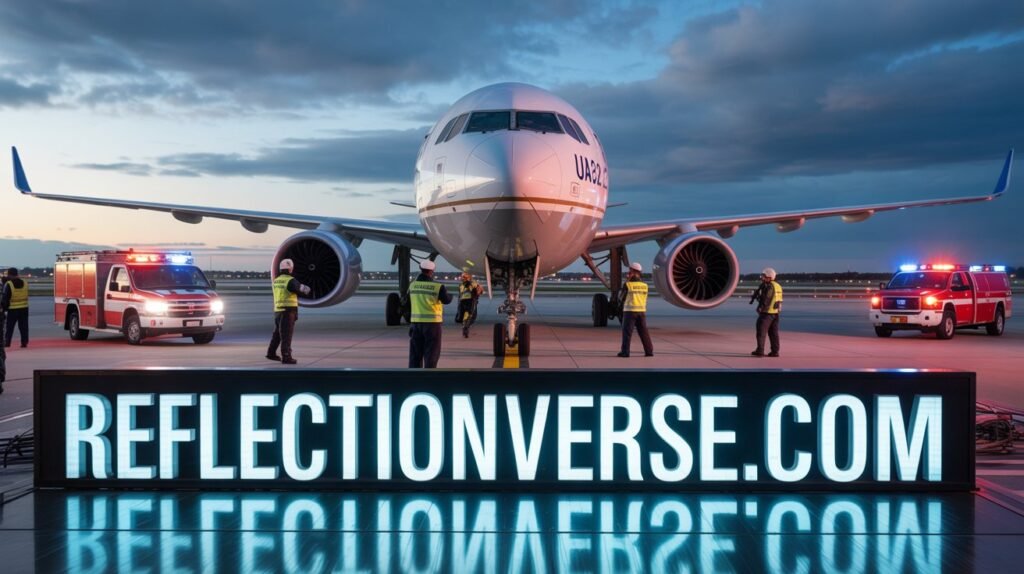
The July 7, 2025 Emergency: A Full Timeline
Departure from Newark
United Airlines flight UA82 departed Newark Airport at 21:21 EDT, bound for New Delhi, India. Passengers settled in as the aircraft climbed into a clear July evening sky. Everything proceeded normally through the initial climb phase.
The Boeing 787-9 reached its cruising altitude and headed northeast, setting course for its transatlantic crossing. The crew and passengers had every reason to expect a smooth, uneventful journey.
The Fault Detected at 33,000 Feet
The aircraft encountered an onboard cooling system issue roughly 45 minutes after takeoff, while cruising at 33,000 feet. This was not a slow-building warning. The system generated an alert that required an immediate crew response.
The crew sent out an ACARS message to the ground. The message identified the fault as a cooling operations issue, specifically referencing Cooling System Number 1. Modern aircraft carry multiple redundant cooling systems, which is precisely why this fault triggered an immediate response rather than being managed in flight.
The ACARS system, which stands for Aircraft Communications Addressing and Reporting System, allows pilots to communicate technical data to ground maintenance teams in real time. This kind of direct communication is part of what makes modern aviation remarkably safe even when faults occur.
Why the Cooling System Matters So Much
You might wonder why a cooling system failure would cause such a serious response. The answer has everything to do with avionics.
The electronics cooling system maintains safe operating temperatures for critical avionics equipment. If these systems overheat, it can lead to failures that compromise safe flight operations. Long-haul flights over oceanic routes must be in perfect working order before continuing.
Think about it this way. You would not drive your car across a desert if your engine cooling system warned you of a critical fault. The same logic applies at 33,000 feet, except the consequences of continued flight over the ocean with compromised avionics cooling are far more serious than pulling over to the side of the road.
The crew made the correct call immediately.
Squawk 7700: The Emergency Declaration
Flight crew squawked emergency transponder 7700 at 02:15 UTC, before carrying out a turnaround and direct track for the departure airport.
Squawk 7700 is the universal aviation emergency code. When pilots set this transponder code, air traffic control receives an immediate visual alert on their radar screens. Every controller in the airspace prioritizes that aircraft. Traffic clears. Direct routing opens up. The aircraft gets whatever it needs.
The Boeing 787-9 made a U-turn over the Gulf of Maine due to the technical issue. The crew communicated with air traffic control throughout the return, maintaining the squawk 7700 code to ensure continuous landing priority.
The Return to Newark
Having been vectored to the north, United flight UA82 made its approach to Newark Liberty International Airport. The flight was positioned for a base entry for runway 22R before establishing on final approach for runway 22L, maintaining transponder code 7700 for landing priority.
The Boeing 787-9, operating under flight number UA82, safely returned to Newark around 11:15 p.m. after departing at 9:30 p.m. Passengers and crew disembarked without incident.
The entire emergency sequence, from fault detection to landing, lasted less than two hours. No injuries were reported. No structural damage occurred. The aircraft performed exactly as designed and the crew executed every procedure by the book.
What Passengers Experienced on Board
When a flight declares an emergency and turns around, the experience for passengers is understandably tense. Most travelers had no idea what was happening in the cockpit during those critical minutes.
Passengers reported hearing the engines change pitch as the aircraft began its turn. The announcement from the flight deck came shortly after, informing everyone that the aircraft was returning to Newark due to a technical issue. Flight attendants remained calm and professional throughout, which played a major role in keeping the cabin atmosphere controlled.
For many passengers, the longest part of the experience was the waiting. After landing, they disembarked normally and faced the process of rebooking a delayed transoceanic flight. The airline estimated a new departure at 11:50 p.m., suggesting a relatively quick turnaround was planned for the rebooking process.
If you ever find yourself in a similar situation, here is what you need to know:
- Follow crew instructions immediately. Flight attendants receive extensive training for exactly these scenarios. Trust their guidance.
- Stay calm and stay seated until instructed. Panicking creates additional risk for everyone on board.
- Listen for crew announcements. The flight deck will communicate what is happening and what to expect next.
- Ask crew about rebooking options. Airlines are required to assist passengers when a flight returns due to a mechanical fault.
- Document the incident. If your plans were significantly disrupted, documentation supports any compensation claim.
The Boeing 787-9 Dreamliner: Built for Exactly This
The Boeing 787-9 at the center of this incident is not just any aircraft. It is one of the most technologically sophisticated commercial planes ever built.
The 787 series introduced composite materials, more efficient engines, and a dramatically improved passenger environment compared to earlier wide-body jets. Critically, it also introduced redundant systems across nearly every major function, including cooling, hydraulics, electrical generation, and avionics.
The fact that the cooling system fault was detected, flagged, and communicated to the ground through ACARS before any secondary systems were compromised is exactly how the 787 was designed to work. The aircraft generated its own warning, the crew responded correctly, and the built-in redundancy ensured the return flight was safe and controlled.
This is not a story about a dangerous aircraft. It is a story about a system working as intended.
How the GEnX Engines Performed
The aircraft is powered by two advanced GEnX engines and was engineered for intercontinental flights, ensuring a controlled return despite the technical issue.
The GEnX engine is one of the most reliable powerplants in commercial aviation. Throughout the emergency sequence, both engines performed normally. The aircraft had full power throughout its return to Newark. The cooling issue was isolated to the avionics electronics system, not to the propulsion system.

What Is Squawk 7700 and Why Does It Matter?
The term squawk 7700 appears repeatedly in coverage of the UA82 emergency. If you are not an aviation enthusiast, here is a plain-language explanation.
Every aircraft flying under instrument flight rules uses a transponder to broadcast its identity and position to air traffic control radar. Pilots set a four-digit code on that transponder. Normal assigned codes identify the specific flight. Three emergency codes exist for specific situations:
- Squawk 7700: General emergency
- Squawk 7600: Radio communication failure
- Squawk 7500: Hijacking in progress
When a crew sets 7700, radar screens at every nearby ATC facility show an immediate alert. The aircraft receives absolute priority for airspace, routing, and landing. No traffic will be placed in its path. Runways clear. Emergency services position themselves along the landing runway as a precaution.
Flight crew are maintaining squawk code 7700 for landing priority. This is standard procedure during an emergency return. Keeping the code active through landing ensures the crew never has to fight for ATC attention or routing at any point during the approach.
How United Airlines Responded
United Airlines’ ground response to the UA82 emergency demonstrated the operational infrastructure that major carriers maintain for exactly these situations.
Maintenance teams were ready when the aircraft landed. Ground staff prepared to assist passengers. Rebooking systems activated for affected travelers. The airline coordinated a new departure estimate within the same evening, showing that the disruption, while significant, was handled efficiently.
United Airlines has maintained a strong safety record across its long-haul international network. The carrier operates one of the largest fleets of Boeing 787 Dreamliners in the world, and incidents like the UA82 cooling system fault inform ongoing maintenance protocols and inspection procedures.
Previous Similar Incidents on United’s Network
This incident did not occur in isolation. This incident followed a previous precautionary landing in 2025 by another United Airlines aircraft, Flight UA1321, which returned to Newark on April 28 due to an unspecified mechanical irregularity.
Aviation analysts note that precautionary returns and emergency declarations are not rare events across the global fleet. Thousands of commercial flights operate daily. When a fault is detected, the correct response is always to return or divert. The number of declared emergencies that result in injury is extremely small, precisely because crews follow established protocols every time.
What Aviation Safety Experts Say
The aviation safety community viewed the UA82 emergency as a textbook example of correct crew decision-making.
Pilots operate under a fundamental principle: when in doubt, do not continue. Over the ocean, the options for diversion shrink dramatically. The decision to return to Newark while still within reasonable range of the airport, rather than continuing toward the transatlantic crossing with a compromised avionics cooling system, reflects exactly the kind of conservative, safety-first judgment that keeps passengers safe.
The ACARS system’s role in this incident also drew attention from analysts. The ability to communicate precise technical fault data to ground maintenance teams in real time means that by the time the aircraft landed, maintenance personnel already understood what they were looking for. That kind of real-time data sharing reduces diagnosis time and helps get aircraft back into service more quickly and safely.
The crew’s decision to squawk 7700 as soon as the fault was confirmed also reflects best practice. Declaring an emergency activates the full safety apparatus of the airspace system. It costs nothing to declare and ensures maximum support.
What This Means for Passengers on Long-Haul International Flights
If you fly internationally, the UA82 emergency offers some genuinely useful perspective.
Modern Aircraft Are Extraordinarily Safe
The Boeing 787-9 detected its own fault, communicated it to the ground, and the crew responded correctly. No single point of failure threatened the aircraft. The redundant systems that aviation engineers spend years designing functioned exactly as intended.
Crew Training Is Exceptional
The pilots and flight attendants on UA82 managed a high-pressure situation with calm professionalism. Flight crews train repeatedly for emergency scenarios. When a real emergency occurs, that training takes over. You are in good hands.
Emergencies Almost Always End Safely
The United Airlines flight UA82 emergency serves as a real-world example of aviation safety working exactly as intended. A technical fault was detected early, pilots responded immediately, and the aircraft returned safely without harm to passengers or crew.
The overwhelming majority of aviation emergencies, including those involving declared squawk 7700 situations, end with safe landings and no injuries. The data on commercial aviation safety is clear and reassuring.
Your Rights as a Passenger
When a flight returns due to a mechanical issue, you have rights. Airlines are generally required to rebook you on the next available flight to your destination at no additional cost. You may also be entitled to meal vouchers, accommodation if the delay extends overnight, and compensation depending on your country of departure and the airline’s contract of carriage.
Always ask the gate agent or airline customer service representative about your specific entitlements when a flight is disrupted due to a mechanical fault.
The Broader Aviation Safety Picture
The UA82 incident fits within a broader context of global aviation safety that deserves recognition.
Commercial aviation is statistically the safest form of long-distance travel in human history. The rate of fatal accidents per mile traveled is dramatically lower than for automobiles, trains, or even walking in urban environments. This remarkable safety record exists because of systems like ACARS, transponder codes, redundant aircraft systems, and the rigorous training that every commercial pilot undergoes.
Every incident that ends safely, including the UA82 emergency, contributes to the continuous improvement of aviation safety. Maintenance teams analyze faults. Engineers review system performance. Airlines update their maintenance schedules. Regulators review data. The feedback loop that keeps aviation safe runs continuously, and incidents like this one feed directly into it.
Conclusion
The United Airlines flight UA82 emergency on July 7, 2025 was a frightening moment for everyone on board. A cooling system fault at 33,000 feet, a squawk 7700 declaration, a U-turn over the Gulf of Maine, and an emergency return to Newark would test the nerves of any traveler.
But what the incident actually demonstrated was a safety system working exactly as designed. The aircraft detected the fault. The crew responded correctly and immediately. Air traffic control cleared the path. Emergency services stood by. The Boeing 787-9 landed safely. Every single passenger and crew member walked off the aircraft without injury.
That outcome is not luck. It is the result of decades of aviation engineering, rigorous crew training, redundant systems, and a global safety culture that treats every fault as an opportunity to protect lives.
If this story teaches you anything as a traveler, let it be this: the people and systems responsible for your safety in the air take their jobs with extraordinary seriousness. The next time your flight hits a bump or you hear an unusual sound, remember UA82. Remember that the system is designed to detect problems early, respond swiftly, and land everyone safely.
Have you ever experienced an in-flight emergency or unexpected return to an airport? Share your experience in the comments below. If you found this breakdown helpful, pass it along to a friend who has questions about aviation safety or long-haul international travel.
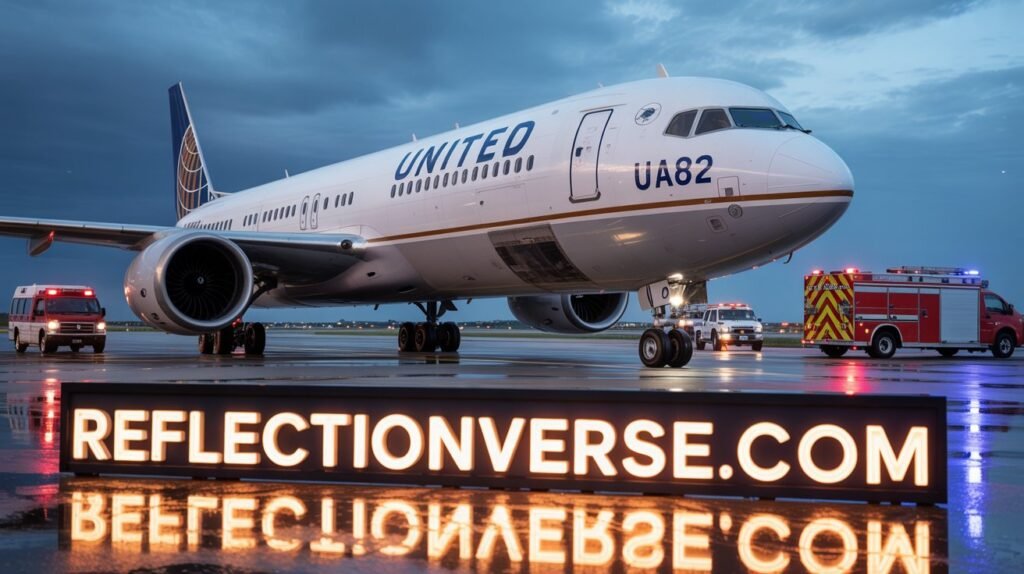
Frequently Asked Questions About United Airlines Flight UA82 Emergency
1. What happened on United Airlines flight UA82? On July 7, 2025, United Airlines flight UA82, a Boeing 787-9 Dreamliner operating from Newark to New Delhi, declared an emergency approximately 45 minutes after takeoff due to an electronics cooling system fault. The crew squawked 7700, turned the aircraft around over the Gulf of Maine, and returned safely to Newark.
2. Was anyone hurt on UA82 during the emergency? No. All passengers and crew disembarked safely without any reported injuries. The emergency return was precautionary and the aircraft performed normally throughout.
3. What caused the UA82 emergency? The aircraft experienced a fault in its onboard electronics cooling system. This system keeps critical avionics equipment at safe operating temperatures. A failure of this system on a long transoceanic route is classified as a serious enough fault to require an immediate return to the departure airport.
4. What does squawk 7700 mean? Squawk 7700 is the universal aviation emergency transponder code. When pilots set this code, air traffic control receives an immediate alert on radar and grants the aircraft absolute priority for routing and landing.
5. What aircraft was involved in the UA82 emergency? The flight operated on a Boeing 787-9 Dreamliner registered as N23983, a 4.8-year-old aircraft powered by two GEnX engines.
6. Where did the UA82 emergency flight land? The aircraft returned to Newark Liberty International Airport, its departure airport, landing on runway 22L at approximately 11:15 p.m. local time, nearly two hours after its original departure.
7. What is ACARS and how did it help in this incident? ACARS stands for Aircraft Communications Addressing and Reporting System. It allows pilots to send technical fault data to ground maintenance teams in real time. In this case, the crew used ACARS to communicate the specific cooling system fault to ground personnel before landing, allowing for faster diagnosis and response.
8. Was this the first emergency involving a United Airlines flight from Newark? No. A previous United Airlines flight, UA1321, returned to Newark on April 28, 2025 due to a mechanical irregularity. Precautionary returns and emergency declarations occur across all major airlines as part of normal safety operations.
9. How did United Airlines handle the passengers after the emergency? United Airlines worked to rebook passengers and estimated a new departure at 11:50 p.m. on the same night. Affected passengers were entitled to rebooking assistance and applicable compensation per United’s contract of carriage.
10. Is the Boeing 787-9 Dreamliner safe to fly on? Yes. The 787-9 is one of the most technologically advanced and safety-tested commercial aircraft in the world. The UA82 incident actually demonstrates the aircraft’s safety systems working correctly: the fault was detected automatically, communicated to the ground through ACARS, and the crew responded with a textbook emergency return.
also read: reflectionverse.com
email: johanharwen@314gmail.com
Author Name: Richard Calloway
About the Author : Richard Calloway is an aviation journalist and flight safety analyst with over 11 years of experience covering commercial aviation incidents, airline operations, and aerospace technology. He has contributed to leading aviation publications and specializes in translating complex technical events into clear, accurate, and reader-friendly reporting. A private pilot himself, Richard writes with both technical depth and genuine passion for making aviation safety accessible to every traveler. When not writing, he tracks global flight data and follows regulatory developments at the FAA and EASA.