Introduction
Austin woke up to a terrifying reality this weekend. A 19-hour shooting spree ripped through South and East Austin, leaving residents shaken, fire stations struck by gunfire, and an entire neighborhood under a shelter-in-place order.
If you have been following the Austin shooting today news today, you already know this situation was unlike anything the city has seen in recent memory. Twelve separate shooting incidents. Four victims. Two fire stations hit. Stolen vehicles used to evade law enforcement across multiple parts of the city.
By Sunday night, May 18, 2026, all three suspects were in custody. Two teenage boys, aged 15 and 17, were apprehended following a car chase in Manor. A third suspect was detained hours later after an exhaustive search involving nearly 200 officers, canine units, SWAT teams, helicopters, and drones.
This article gives you the complete, verified picture of what happened, who was involved, how law enforcement responded, what Austin’s leaders are saying, and what questions this incident leaves unanswered for the city going forward.
What Happened: The Full Timeline
It Began Saturday Afternoon
The 19-hour spree began late Saturday afternoon, with the first calls coming in around 3:45 p.m. Saturday. The first shooting happened in the 6700 block of Wentworth Drive in east Austin, where the suspect fired toward Fire Station 26.
From that first incident, things escalated quickly. The first call came from a person around 4 p.m. Saturday who reported their vehicle stolen from an Austin apartment complex. Not long after, another call came in about a stolen gun. Over several hours, around 20 calls came in for shootings, primarily in South and Southeast Austin, including at two fire stations.
The suspects were not staying in one place. They were moving fast, switching stolen vehicles, and striking targets across a wide geographic area. That mobility made them extremely difficult to track in the early hours of the spree.
Saturday Night: Fire Stations Targeted
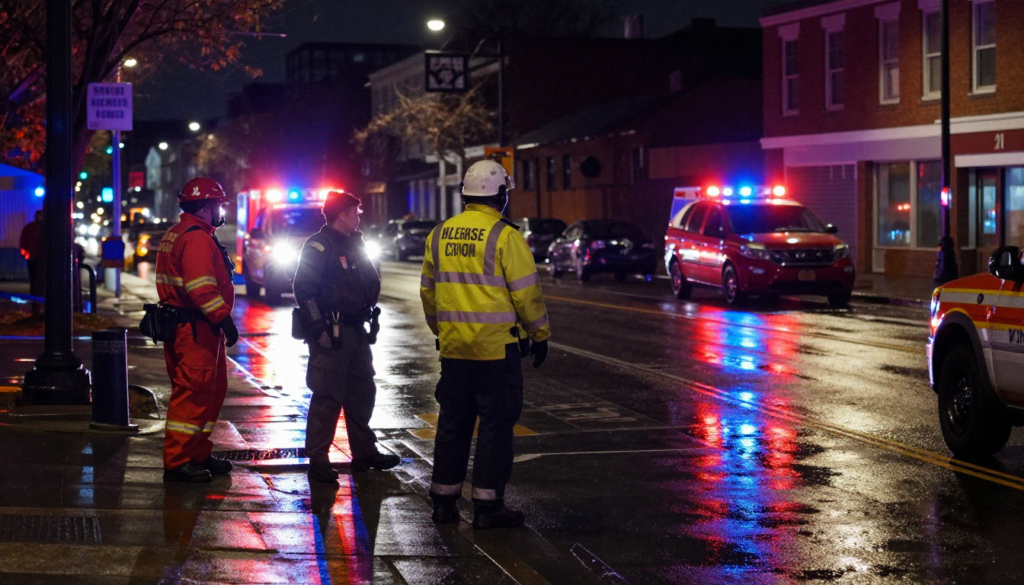
According to Austin Fire, AFD Station 26, located in east Austin, was shot at around 9 p.m. Saturday. Austin Police said a second shooting occurred at AFD Station 32, located in southwest Austin, on Sunday around 10:50 a.m. No one was hurt, but APD said the building was hit with gunfire. AFD said the gunshots hit the station’s garage door and one of the apparatuses in the bay.
Think about the sheer boldness of that. These suspects drove up and opened fire on active fire stations, with emergency personnel standing nearby. Mayor Kirk Watson said that includes two at different fire stations, including one when a firetruck was hit with gunfire with fire personnel standing right behind it.
Firefighters responded the only way they know how. Austin firefighters continued to answer every call for help, just as they always do, said David Girouard, president of the Austin Firefighters Association. Austin Fire Department members continued to respond city-wide to other reported shootings and to care for victims.
The Shootings Paused, Then Resumed Sunday
The shootings paused overnight before resuming Sunday morning at 8:47 a.m., when a man walking his dog was shot in the back near the intersection of Janes Ranch Road and Ballydawn Drive in southeast Austin. Police then began connecting the incidents.
That moment, when investigators began linking the incidents together, changed the entire scope of the response. What initially appeared to be isolated incidents suddenly became a coordinated pattern.
Sunday Afternoon: Shelter-in-Place Issued
A shelter-in-place alert that went out just before 3:30 p.m. Sunday covered an area of South Austin bordered by Slaughter Lane, McKinney Falls Parkway, Ben White Boulevard and Escarpment Boulevard.
Residents across South Austin were told to stay inside and lock their doors while law enforcement worked to track the suspects. Schools, businesses, and community members all went into lockdown mode as the search intensified.
Sunday Evening: All Three Suspects in Custody
The break in the case came when technology helped do what patrol officers on the ground could not. Shortly after 3:20 p.m. Sunday, Manor police used Flock Safety technology to locate a vehicle believed to be involved in the incidents. Law enforcement found the vehicle near South San Marcos Street and East Carrie Manor Street, before a pursuit ended near the 13600 block of North FM 973 Rd. Three people then fled the vehicle.
The incident ended with a car chase involving Manor police and several other law enforcement agencies around 5 p.m. When authorities in Manor stopped the vehicle, three suspects ran from the car. Two were caught almost immediately. The third remained at large for several more hours.
The third suspect remained on the run throughout most of the day but was eventually detained by Manor police at around 9:30 p.m.
Manor police ended an exhaustive search that involved nearly 200 officers, including canine, SWAT, helicopter, and drone support.
The Victims: What We Know
One shooting victim sustained serious injuries and three others have minor injuries, Austin Police Chief Lisa Davis said Sunday.
Four people were injured, including one person who was critically wounded but is now stable, and multiple buildings, including two fire stations, were struck by gunfire.
The most chilling moment captured on video came from a pole camera. A pole camera captured one of the shootings on video, showing the suspects firing from a vehicle at a woman standing outside a store.
Austin Travis County EMS responded swiftly to the most critical victim. Austin Travis County EMS Chief Rob Luckridge said three victims sustained non-life-threatening injuries and one was critically injured and received whole blood treatment on scene before being transported to a local trauma center.
The fact that no one was killed in 12 separate shooting incidents is nothing short of remarkable. It speaks to the rapid response of Austin Travis County EMS and the trauma care capabilities at local hospitals, and perhaps to a measure of fortune that cannot be taken for granted.
The Suspects: Two Teenagers With Stolen Guns
This is where the story takes a particularly disturbing turn. The primary suspects in one of Austin’s most alarming crime sprees in years are teenagers.
A 15-year-old and a 17-year-old with stolen guns were taken into custody following a car chase in Manor, Davis said.
Austin Police Chief Lisa Davis identified two suspects as a 15-year-old and a 17-year-old. The 17-year-old had an existing warrant for the theft of a firearm from the same store where the 15-year-old had stolen a gun from Saturday.
Both firearms used in the shootings were stolen. The 17-year-old had already been flagged in the system for a prior gun theft, meaning there was an existing warrant that had not yet resulted in his apprehension when Saturday’s events began.
The two teenage suspects have not been identified but will be placed in juvenile detention, Davis said.
How They Evaded Police for So Long
The suspects’ ability to stay ahead of law enforcement for nearly 19 hours came down to one tactic: constant movement with stolen vehicles.
Davis said the suspects also fired at apartment buildings. Officers, in turn, went door-to-door to ensure everyone in the apartment buildings was safe. The chief said on Sunday afternoon that investigators were searching for multiple suspect vehicles, including a black or dark blue Hyundai, a gold Hyundai sedan, a silver four-door Mazda and a white Kia Optima. Davis said at least four vehicles were stolen.
Every time police zeroed in on a vehicle description, the suspects switched cars. That constant rotation kept them one step ahead until Manor police used Flock Safety license plate reader technology to pin down the white Kia.
The Locations: Where the Shootings Happened
Understanding the geographic scope of this spree helps explain why it was so difficult to contain. This was not a single-neighborhood incident. Shots were fired across a wide swath of the city.
Confirmed shooting locations and targets included:
- Fire Station 26 in East Austin, struck Saturday night around 9 p.m.
- Fire Station 32 in Southwest Austin, struck Sunday morning around 10:50 a.m.
- Janes Ranch Road in Southeast Austin, where a man walking his dog was shot Sunday morning
- A store in South Austin, where a pole camera captured two people being shot from a passing vehicle
- Multiple apartment buildings in South and Southeast Austin
- Homes and businesses across South Austin
Davis said most of the shootings occurred in South Austin. However, the incidents stretched from East Austin to Southwest Austin, covering a significant portion of the city.
The Law Enforcement Response
This operation required an enormous, coordinated effort from multiple agencies. By the time the manhunt concluded, an extraordinary number of officers from across the region were involved.
The agencies that participated in the response included:
- Austin Police Department
- Austin Fire Department
- Austin Travis County EMS
- Travis County Sheriff’s Office
- Texas Department of Public Safety
- Manor Police Department
This truly is an example of how all of our public safety here in the city of Austin comes together, Austin-Travis County EMS Chief Rob Luckritz said during the briefing.
The shelter-in-place order, while disruptive, served its purpose in keeping residents safe while officers focused on finding the suspects. The shelter-in-place order for parts of South Austin had been lifted by Sunday evening.
What Austin’s Leaders Said
Mayor Kirk Watson
Mayor Kirk Watson addressed the community directly and did not sugarcoat the gravity of the situation. Watson said no motive has been identified and the shootings appear to be random.
Watson also contacted state leadership. Mayor Kirk Watson said he had also been in contact with Manor Mayor Christopher Harvey and Governor Greg Abbott, who extended his support to the city.
Watson and Davis both addressed the topic of license plate reader technology in their Sunday press conference. Davis acknowledged that license plate reader technology could have aided the investigation, and both she and Mayor Watson said they are open to revisiting the city’s policies on that technology going forward.
Police Chief Lisa Davis
Chief Davis was direct in her assessment of what happened and what it means. “I don’t know what motive would drive anybody to drive around senselessly in this city, in multiple parts of this city, shooting,” she said.
Davis also reflected on what made this case so difficult to crack in the early hours. Davis said the constantly changing vehicles, combined with the spread of the incidents across South Austin, made it difficult in the early hours to connect the calls.
Her final statement at Sunday’s press conference was resolute. “This is a serious situation, and we will let the justice system at this point take over,” Davis said.
The Role of Technology: How Manor Police Caught the Suspects
One of the clearest takeaways from this entire incident is the role that surveillance and tracking technology played in ending it. Without Flock Safety license plate reader technology, the third vehicle may not have been located as quickly.
During the press conference, both Watson and Davis suggested the incident could renew conversations about the city’s use of license plate reader technology, saying the tools may have helped investigators track the stolen vehicles more quickly.
Austin has historically been cautious about adopting certain surveillance technologies due to privacy concerns from community advocates. This weekend’s events are likely to reignite that debate in a very public way. The fact that Manor police, operating under different technology policies, used plate readers to locate the suspect vehicle adds a pointed dimension to that conversation.
The incident also highlighted how effective multi-agency coordination can be when it works smoothly. Close to 200 officers from multiple departments, using overlapping tools and shared intelligence, ultimately resolved a situation that could have ended far worse.
The Motive Question: Still Unanswered
Perhaps the most unsettling aspect of the entire weekend is that investigators still cannot explain why it happened.
The motive remains unknown for the 12 separate shooting incidents, which authorities believe involved at least four stolen vehicles.
“We had two individuals that were going and robbing cars, and then started firing shots at people,” Davis said Sunday evening.
What started as a vehicle theft quickly escalated into something far more dangerous and far more random. The shooting of fire stations, the targeting of apartment buildings, the attack on a woman standing outside a store — none of these incidents have an obvious connective motive beyond opportunistic violence by individuals with stolen firearms and stolen vehicles.
That randomness is exactly what makes incidents like this so frightening for a community. There is no specific location to avoid. No clear target profile. Just 12 incidents spread across a city of nearly one million people, carried out in less than 24 hours.
How to Report Information
Law enforcement is asking anyone with additional information to come forward. Anyone with information is asked to contact APD’s Aggravated Assault Unit at 512-974-5177. Tips may also be submitted anonymously through Capital Area Crime Stoppers online or at 512-472-8477. A reward of up to $1,000 is available for information leading to an arrest.
If you live in the affected areas and have security camera footage, witnessed any of the incidents, or have information about additional suspects or vehicles, contacting APD or Crime Stoppers is the right next step.
What This Means for Austin Going Forward
The Gun Theft Issue
Two teenagers with stolen firearms carried out one of Austin’s most alarming crime sprees in years. That fact points directly to a broader issue around gun theft and how quickly stolen weapons end up in dangerous hands.
The 17-year-old had an existing warrant for a gun theft that had not been executed when Saturday began. The 15-year-old allegedly stole a gun from the same store on the day the spree started. Both stole weapons from a retail location, suggesting the store may also face scrutiny about its security protocols.
The Juvenile Justice Question
Both primary suspects will enter the juvenile justice system. Their identities have not been released due to their ages. The question of what accountability looks like for minors who commit crimes of this severity is one that Austin, like many cities, will need to grapple with openly.
The Technology Policy Debate
The city’s existing caution around license plate readers may now face renewed political pressure. When the tool that ended a 19-hour shooting spree was a license plate reader operated by a neighboring municipality, the argument for expanding that technology within Austin’s own department becomes harder to dismiss.
Conclusion
The Austin shooting today events of May 17 and 18, 2026 represent one of the most frightening 19-hour periods the city has experienced in recent years. Twelve separate shooting incidents. Four victims. Two fire stations struck. An entire South Austin neighborhood under shelter-in-place. And two teenagers with stolen guns at the center of it all.
By Sunday night, all three suspects were in custody. The immediate danger has passed. But the questions this weekend raised are not going anywhere. About gun theft. About juvenile crime. About surveillance technology. About what a city of nearly one million people owes its residents in terms of public safety.
Austin has faced hard moments before and responded with resilience. The near-200-officer response that ended this spree, the firefighters who kept answering calls while their own stations were targets, and the community members who stayed alert and shared information — all of it reflects a city that refuses to be paralyzed by fear.
If you have information related to this incident, contact APD at 512-974-5177 or Crime Stoppers at 512-472-8477. And if you have thoughts on what Austin should do differently going forward, share them. These are conversations the whole city needs to have.

Frequently Asked Questions About the Austin Shooting Today
1. How many shootings happened in Austin this weekend? There were at least 12 separate shooting incidents across Austin between Saturday afternoon, May 17, and Sunday evening, May 18, 2026. Most occurred in South and East Austin.
2. How many people were injured in the Austin shooting spree? Four people were injured. One sustained serious injuries and was critically wounded but is now in stable condition. Three others sustained minor injuries.
3. Were any people killed in the Austin shootings? No fatalities have been reported. All four shooting victims survived, including the one person who was critically injured and received emergency treatment on scene.
4. Who were the suspects in the Austin shooting today? Three suspects, all male and described as being in their late teens, are in custody. Two have been identified as a 15-year-old and a 17-year-old. Both will be placed in juvenile detention. The third suspect was detained by Manor police late Sunday night.
5. What was the motive for the Austin shootings? No motive has been identified. Austin Police Chief Lisa Davis and Mayor Kirk Watson both stated that the shootings appear to be random. The suspects allegedly began by stealing cars and then began firing at people and buildings.
6. Were Austin fire stations really targeted? Yes. AFD Station 26 in East Austin was struck Saturday night, and AFD Station 32 in Southwest Austin was struck Sunday morning. No firefighters were injured, but gunshots hit the garage door and a fire apparatus at Station 32.
7. Was there a shelter-in-place order in Austin? Yes. A shelter-in-place order was issued Sunday afternoon for parts of South Austin, covering the area bordered by Slaughter Lane, McKinney Falls Parkway, Ben White Boulevard, and Escarpment Boulevard. The order was lifted Sunday evening.
8. How did police catch the suspects? Manor Police used Flock Safety license plate reader technology to locate a white Kia Optima believed to be connected to the incidents. A car chase followed, during which all three suspects fled the vehicle on foot. Two were caught at around 3:50 p.m. Sunday, and the third was detained at approximately 9:30 p.m.
9. How many officers were involved in the manhunt? Nearly 200 officers participated in the search, including canine units, SWAT teams, helicopters, and drone support from multiple agencies including APD, the Travis County Sheriff’s Office, the Texas Department of Public Safety, and Manor Police.
10. How can I report information about the Austin shooting today? Contact the Austin Police Department’s Aggravated Assault Unit at 512-974-5177, or submit anonymous tips through Capital Area Crime Stoppers at austincrimestoppers.org or by calling 512-472-8477. A reward of up to $1,000 is available for information leading to an arrest.
also read: reflectionverse.com
email: johanharwen@314gmail.com
Author Name: Tyler Jameson
About the Author : Tyler Jameson is an investigative news writer and public safety journalist with over nine years of experience covering crime, law enforcement, and community issues across Texas. He has reported on major incidents from Austin to Dallas and specializes in translating fast-moving breaking news into clear, accurate, and reader-first reporting. Tyler believes good journalism serves the public, especially in moments of uncertainty and fear.